BASEBALL 2024 RULES
Revised (updated May, 2024) *Note changes where emphasized in Bold
- Players will conduct themselves in a civil manner and in the spirit of good sportsmanship. There is a zero-tolerance policy towards violence and verbal abuse.
- All male players must be 55 years of age or older. Female players must be 50 years of age or older…. Players can turn that age during that calendar year. (ex: a female can play at 49 years old if their birthday is before the end of December).
- There must be at least three (3) female players on the field at all times. At least one (1) female must be playing the infield excluding the pitcher and catcher. If only 2 females are available, the team will field eleven (11) players. If only 1 female, then you field ten (10) players. No females, you field nine (9) players. The requirement of having one (1) female in the infield still applies. If no females are available, then one (1) infield position must be vacant.
- The top 4 batters must consist of two (2) males and two (2) females in any order. The remainder of the batting order has no restrictions….Managers please take into account the new ‘pinch runner’ rules when filling our your batting order!
- Defensively, a team can only have 12 players on the field. The 9 standard players and 3 rovers. All players will be in the batting order. If a team is short of their required three (3) females, then an out will be recorded each time that batting spot comes up.
- If any batter gets four (4) balls and no strikes, the next person to bat has the option of taking a walk. Encourage that next batter to bat.
- Any batter that requires a runner from the plate will be announced at the beginning of the game when teams exchange their line-ups. This may be updated if an injury occurs during the game. The runner from the plate will be of the same sex as the batter and will be the person that was the ‘last out’ recorded. IN the case of no ‘last out’ then the person (same sex) furthest away in the batting order from the batter will pinch run.
- 1st base will remain with its safety base (orange). If the 1st basemen touches the orange bag while making a play, the runner is safe. 2nd and 3rd base will each have 2 separate bases. One for the fielder and one for the base runner. This is to avoid the chance of collisions. While running the bases the base runner must touch the safety bags. (not the fielders base). In the event that a base runner touches the wrong base, the runner will not be allowed to advance to the next base. (Ex: a runner goes from 1st to 3rd on a hit. They touch the wrong base rounding 2nd on their way to 3rd base. The runner returns to 2nd.
- A team will get 1 (and only 1) warning for a lead off per game. Any further lead offs will result in the runner being called out. The lead off rule applies to the pinch runner from the plate as well, a pinch runner from the plate will be called out if both feet go past the ‘line’ when the batter has not made contact with the ball. The batter will be called out…. No Leadoffs.
- A pinch runner from the plate may only go to 1st base. If the ball is thrown out of bounds, the runner may move up to 2nd base.
- The courtesy runner must start from the extended third baseline that that goes through home plate to the screen.
- In the rare case when a courtesy base runner’s turn comes up to bat. That courtesy runner may be replaced by another runner (last out).
- Once a player reaches any base, that player cannot be replaced with a courtesy runner unless injured.
- If an injured player is unable to retake a defensive position on the field, that player’s spot in the batting order will be passed over and an automatic out will not be registered…. Rule 5 still applies though. If the injured player is a female and that leaves you short the required 3 females, an out will be recorded.
- If a base runner in the process of running to the next base incurs an injury and (if deemed by the umpire would have been safe), that runner will be awarded the base and replaced by a pinch runner. (last out)
- Home plate will be a piece of wood measuring 2 feet by 3 feet.
- If a batted ball hits home plate and goes into the playing field, it is a fair ball and in play.
- If a pitched ball hits the very front of the plate and goes towards the pitcher it will be deemed a strike (Also be aware of the pitch that looks to hit the very front of the plate but continues to the catcher, this is a ball as it hit the plate on the way up).
- if a batter’s foot touches any part of home plate while making contact with the ball at the same time, then the batter is out.
- Home plate is a force out. Once a runner crosses the commitment line, located 20 feet from home plate, that runner may not return to 3rd base.
- To score a run the base runner must touch or cross the extended line from the 1st base line extended through home plate to the screen before the catcher touches home plate in control of the ball. The base runner will be rules ‘out’ if they touch home plate. The catcher or any other fielder may not tag the runner once they have gone past the commitment line. If this occurs, the runner will be deemed safe.
- If a ball goes out of play, then the runner is awarded one (1) extra base. The extra base is awarded from when the throw occurs, not from when the ball goes out of bounds.
- Obstruction is when a defensive player interferes with a base runner. The base runner will be awarded the base.
- Interference is when a base runner interferes with a fielder trying to make a play on the ball. The base runner will be called out.
- Sliding will not be allowed. The base runner will be called ‘out’. A runner may over run all bases. If a base runner turns left and ‘makes an attempt’ to go to the next base, the runner may be tagged out.
- On a ‘non-force’ play, the runner needs to be tagged out as they run to their safety bag. If they are being blocked from their safety bag, the runner will be deemed ‘safe’.
- A foul ball pop up to the catcher must attain a height of at least six (6) feet.
- A pitch must be between 6-12 feet. A pitch outside of these limits will be called a ‘ball’ unless the batter swings at it… Because a low pitch is difficult to call during the actual pitch, an illegal low pitch (under 6 feet) can be called a ball after the fact. The batter may still swing, and a strike will be called.
- It is encouraged that each team have two (2) players that can umpire and are familiar with the baseball rules. Separate these players in the batting order so that one (1) is always available. The 1st base coach can be used as an umpire if both teams agree.
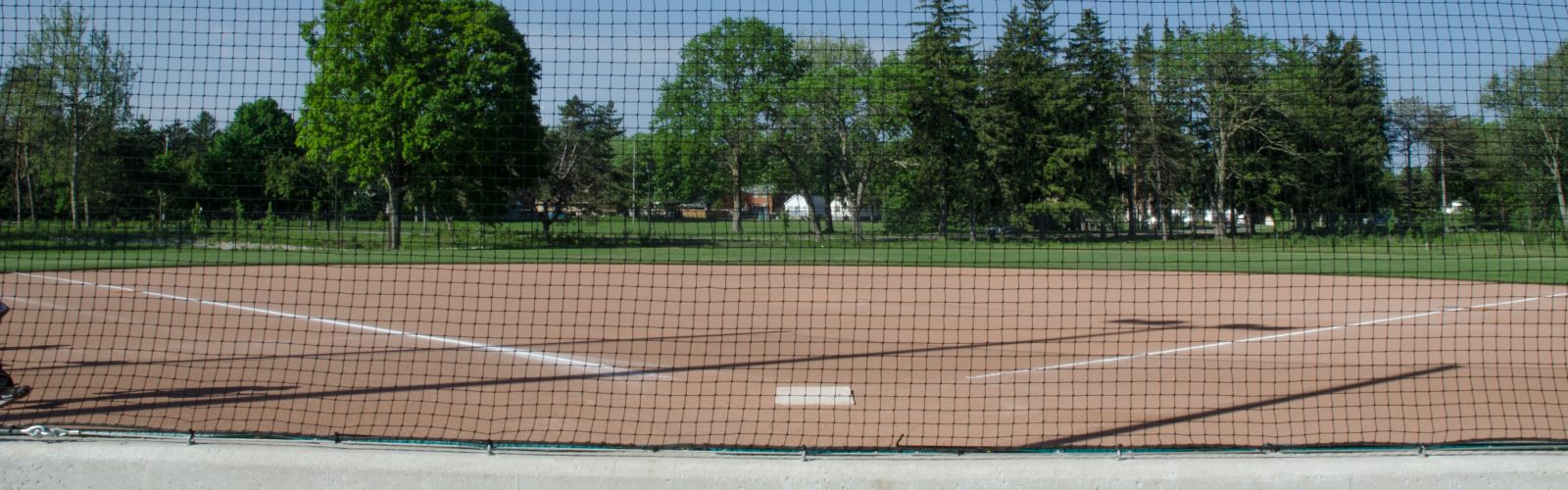
- Bases will be 50 feet apart, with the distance between home plate and 2nd base being 70′ 8″. The pitching mound will have a minimum distance of 38’and a maximum distance of 50′ from the front of home plate. Pitchers must also be positioned in a direct line from home plate to 2nd base. No pitching from a few feet to the side of this imaginary line.
- Outfield ‘rovers’ must be situated on the grass line before the ball is hit. The ‘outfielders’ must be situated 15′ behind the ‘rover’ …On any ball diamond where the ‘grass line’ is deemed to be unreasonably too far out, if both teams agree, the rover position can be moved onto the infield dirt.
- Infielders must not play inside the baseline until the batter hits the ball. The baseline is defined as the direct line between the bases.
- All rainouts will try and be cancelled by 7:30am. If the teams have another game scheduled later in the season, it will consist of a double-header of 5 innings in each game, if possible.
- Games will consist of seven (7) innings. There is a limit of seven (7) runs per team per inning except in the last inning which will be an ‘open’ inning. Once 5 innings or more have been completed and a team is up by 20 or more runs, the game may be called if both teams agree.
- Double headers and tournament games will consist of five (5) innings with the last inning being ‘open’. In any 5-inning game, no inning will start after 55 minutes.
- A player must play 50 % of their team’s games to be eligible for the tournament unless the player was injured during the season.
- Teams may add players to their team up until the halfway mark of the season. These new players must play 50% of the remaining games to qualify for the tournament.
- All players on all teams must be registered with a Senior Center that offers a baseball program. A team using a player not registered will forfeit that game. A second offence could mean your team’s expulsion from the league. This will be determined by the remaining teams.
- Baseball specs are 12” Worth trainer mush balls.
- The commissioner’s position will be for a 3-year term.